Meet the 2026 Open Payments Accelerator Cohort

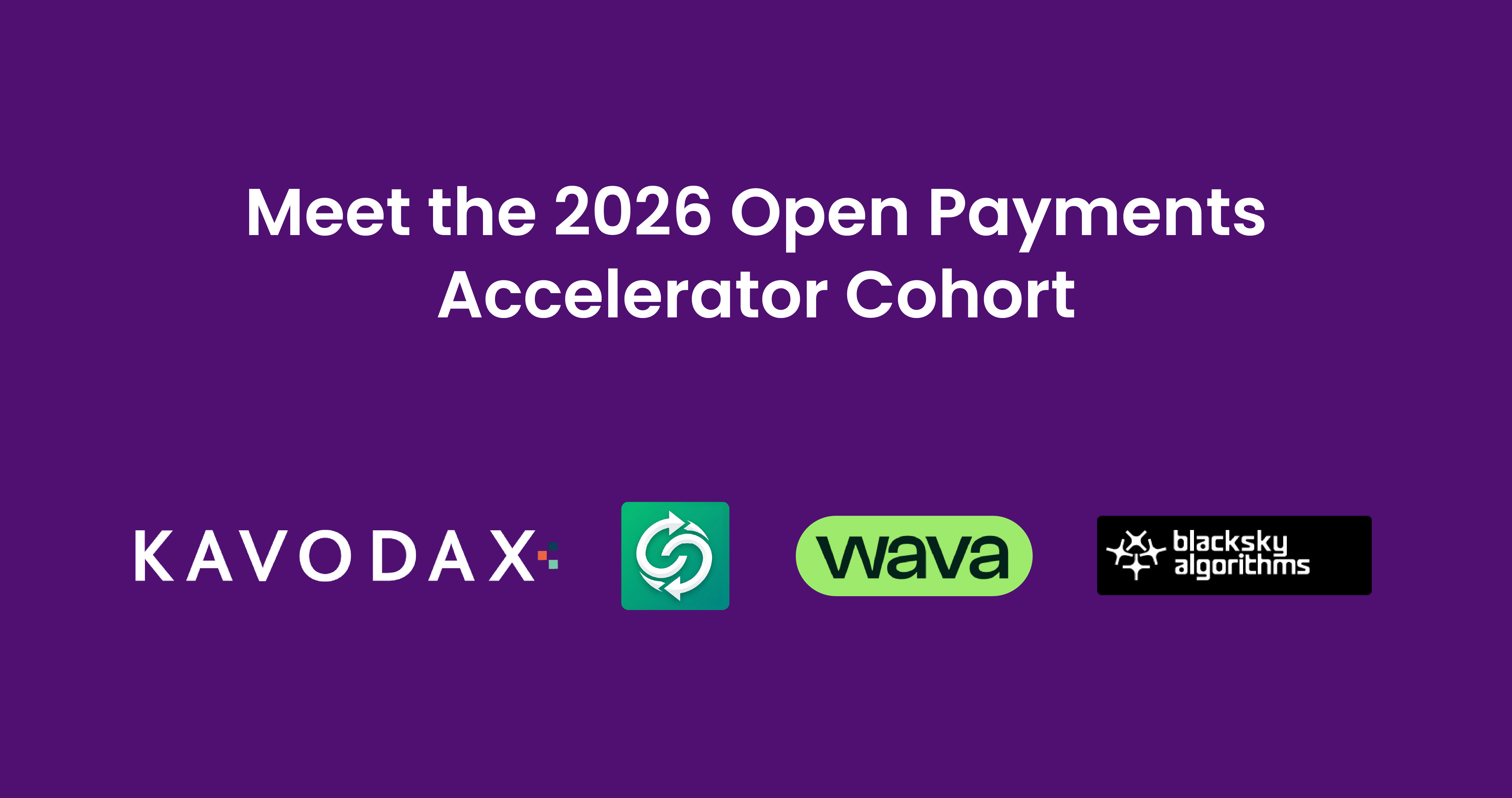
The clearest way to show open payments work is to build with them. That’s what the inaugural cohort of the 2026 Open Payments Accelerator will do: four teams using Open Payments and Interledger technologies to tackle real payment problems across different markets and communities.
The Open Payments Accelerator helps new founders and developers turn their ideas for digital financial services into something real. It runs for four months with support from experts, hands-on workshops, and a cohort of peers building in parallel, as well as $50,000 USD in funding. Teams will spend the next few months testing how Open Payments can be used in their products, payment systems, and local financial networks, refining and strengthening their products along the way. The goal is to create a working Proof of Concept - a test version of their idea, to show that it can really work.
Interest in the pilot program was high. ILF received a total of 209 applications from 56 countries. After a thorough review process, four projects were chosen to be part of the 2026 cohort. Together, they bring a diverse mix of payment use cases, from cross-border payments in Latin America and community-based payments on the open social web to creator monetization and mobile money in East Africa.
Let’s meet them:
Blacksky Algorithms | United States
Making it easier to send community payments using the social identities people already know.
Blacksky Algorithms (opens in a new tab) is building native payment infrastructure for the AT Protocol to enable peer-to-peer payments for mutual aid and community support. By embedding payments directly into the social networks where communities already organize and communicate, the project aims to make financial support more accessible and seamless. Its interoperable approach reduces dependence on separate bank apps, crowdfunding platforms, and external payment links, creating a more connected payment experience across platforms.
By the end of the Accelerator, Blacksky aims to demonstrate an open source payment journey on the Interledger test network in which users can fund, pay by handle, and withdraw across Open Payments wallets.
Read Blacksky’s full project introduction:
Wava | Colombia
Exploring how Open Payments could connect Latin America’s increasingly sophisticated domestic payment rails across borders.
Wava (opens in a new tab) is developing a Proof of Concept to explore how Open Payments can connect existing domestic payment systems for more efficient cross-border transactions without requiring those systems to change. The pilot focuses on the Peru–Colombia corridor, where a customer in Peru will pay using a local payment method, Open Payments will coordinate key transaction details such as the payment address and quote, and the recipient will receive Colombian pesos through a domestic payment system.
The goal is to demonstrate whether Open Payments can serve as an interoperability layer between established local infrastructure, giving merchants a simpler way to collect payments across markets while maintaining the payment experiences their customers already use.
Read Wava’s full project introduction:
ShujaaPay | Kenya
Connecting digital creators to audiences through Open Payments and mobile money.
ShujaaPay (opens in a new tab) is building Happy, a creator platform designed to help Kenyan and emerging-market creators earn directly from their audiences. Using ShujaaPay’s open payments network, creators can offer low-cost, pay-per-view micro-unlocks for digital content, while fans can pay using international payment methods or local mobile money such as M-Pesa. Payments settle quickly and at very low cost, allowing creators to withdraw earnings directly to mobile money or bank accounts. The project supports independent videographers, podcasters, writers, educators, and other creators by turning audience engagement into more accessible and sustainable income.
The team aims to demonstrate a working global-to-local payment experience and explore whether low-cost micropayments could offer creators another way to monetize their work without relying solely on conventional subscriptions or card payments.
Read ShujaaPay’s full project introduction:
Kavodax Inc. | Canada
Exploring whether open standards can make cross-border payment infrastructure easier for financial platforms to connect to.
Kavodax Inc. (opens in a new tab) is a live cross-border payments platform operating across 70+ countries and supporting 30+ currencies. This project focuses on extending Kavodax’s existing infrastructure through open, standards-based payment connectivity, enabling independent financial platforms to connect, verify, authorize, route, and settle transactions without costly custom integrations. By combining Open Payments with Kavodax’s existing banking and digital-asset infrastructure, the project aims to demonstrate a more interoperable model for cross-border payments—making it easier for financial service providers, businesses, and individuals to move money efficiently across global corridors, particularly in Africa and Latin America.
By the end of the program, Kavodax aims to demonstrate that an independent participant can complete a payment through its infrastructure without requiring a custom bilateral integration, while also testing authorization, secure message signing, transaction monitoring, and interoperability between independent systems.
Read Kavodax’s full project introduction:
Four Projects. Four Experiments. One Shared Goal.
While the projects are tackling very different problems, they share a common question: What becomes possible when payments can move across systems using open, interoperable standards?
Over the four-month Accelerator, the teams will build and test focused Proofs of Concept. Along the way, they will work with Interledger technical mentors, participate in dedicated learning and integration sessions, test their assumptions, and share what they learn with the wider community.
The Accelerator is a place where we try new things. It’s not just about getting to the end result, but also about learning what works well with Open Payments and what doesn’t. We want to find out where the challenges are and come up with useful ideas that can help make the whole Interledger ecosystem stronger. By doing this, we can figure out what’s working and what’s not. The goal is to keep learning and improving, so we can make the most of Open Payments and help the Interledger ecosystem grow.
We’re excited to see what’s next for Blacksky Algorithms, Kavodax, Wava, and ShujaaPay as they continue to develop and grow, and we’ll be keeping a close eye on their progress over the coming months, learning from their successes and challenges, and sharing in their experiences.
– Chris Lawrence, Chief Program Officer