Insights from the Interledger Foundation’s session at Financial Inclusion Week 2026

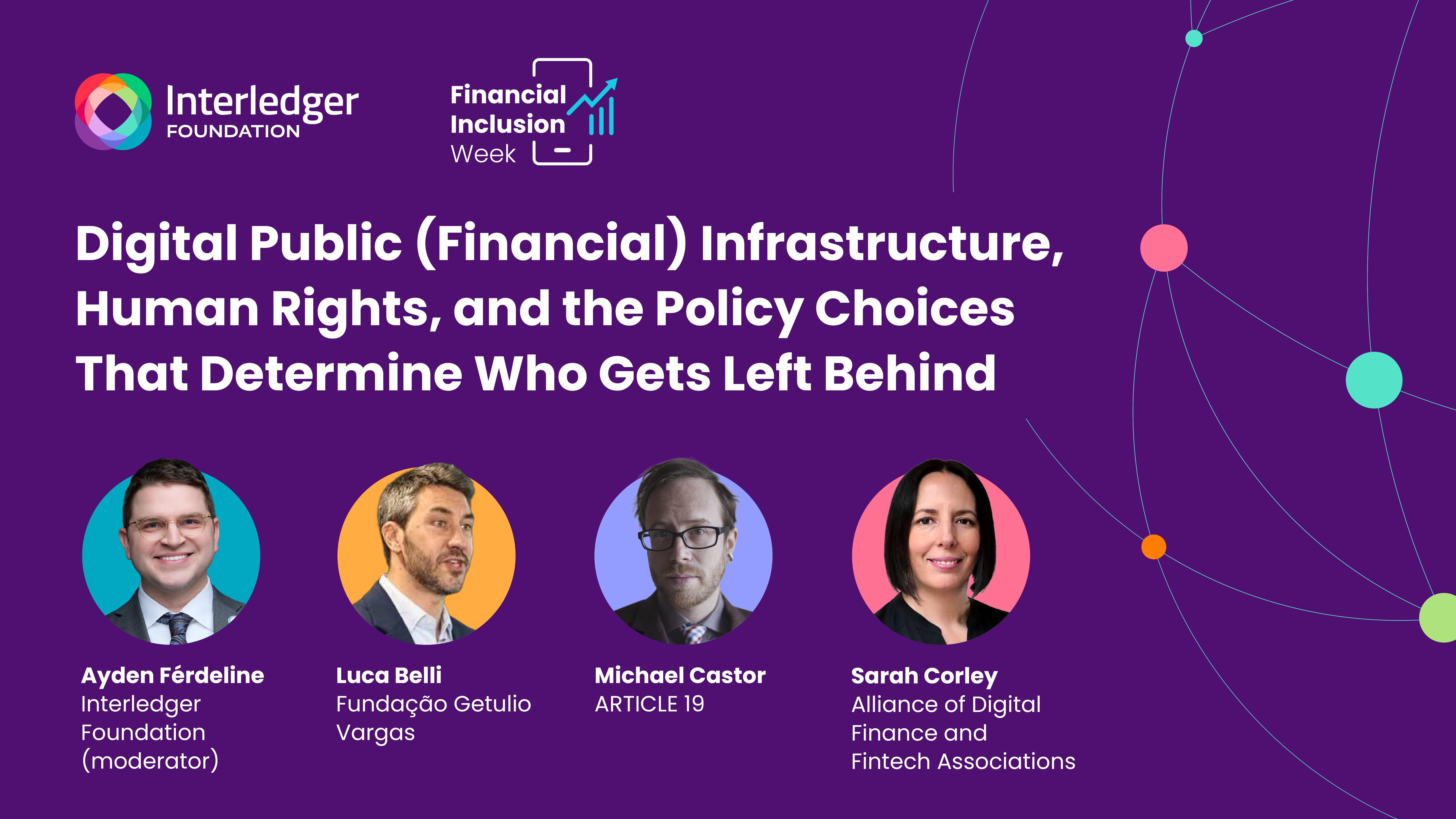
Financial Inclusion Week 2026 (opens in a new tab), convened by the Center for Financial Inclusion, is under way. In an on-demand session moderated by the Interledger Foundation (opens in a new tab), three Interledger Foundation public policy activation grantees examine how governance choices embedded in national instant payment systems determine who can participate, and on what terms.
Instant payment systems are often presented as neutral tools for expanding financial access. But decisions about who may connect, what identity users must prove, and which transactions may be monitored or stopped shape participation in economic life. “The question is never whether a payment system is inclusive,” said moderator Ayden Férdeline, the Interledger Foundation’s Lead for Public Policy and Government Affairs. “It is who decided the terms of inclusion, whether anyone can challenge those terms, and what happens to the person on the wrong side of them.”
Two celebrated systems, two forms of concentration
Luca Belli, Professor of Digital Governance and Regulation at FGV Law School in Rio de Janeiro and Director of its Center for Technology and Society, compared how Brazil and India built their systems and what each design did to power.
Brazil made participation in Pix mandatory for financial intermediaries above 500,000 users, with smaller institutions free to join voluntarily. “If you are sufficiently relevant in the payment market in Brazil, you cannot remain out of Pix,” Belli said, “and to be in, you need to respect some open protocols that define the architecture.” The result displaced Visa and Mastercard, which had carried costs of three to five percent, in favour of a free service organised domestically.
India took a different route, coordinating through the National Payments Corporation of India and leaving market players to compete at the consumer interface. Innovation followed, and so did concentration: roughly three quarters of UPI transactions now run through Google Pay and PhonePe, the latter majority owned by Walmart.
“The honest answer is that neither Brazil nor India have eliminated concentration,” Belli said. “Both systems have designed mechanisms that relocate concentration in quite different ways.” In Brazil, governance capacity sits with a central bank that is “the architect, regulator and operator of Pix,” an arrangement he attributed to an institution that is independent, stable, and reasonably well resourced, “which is extremely rare.”
His conclusion is a warning to anyone hoping to copy either model: “We do not only need open protocols and a modern regulatory framework. We also, and I would say mainly, need the institutional capacity” to bring participants in and to prevent that participation from becoming a new source of concentration. The task ahead, he said, is making concentration “visible, contestable and definitely accountable.”
Eligible on paper, excluded in practice
Sarah Corley, Chief Executive Officer of the Alliance of Digital Finance and Fintech Associations, presented findings from research (opens in a new tab) across low and middle income countries on whether fintechs and non-banks can actually join instant payment systems. The study identified five interrelated barriers: thin commercial margins, licensing and capital requirements built for banks, dependence on sponsor institutions, governance bodies dominated by incumbents, and unreliable or poorly documented technology. A fifth finding was unexpected: in markets without the consumer awareness that Pix and UPI achieved, smaller providers carry the cost of explaining instant payments to customers themselves.
“An important distinction that we found was between being on paper technically eligible to participate in instant payment systems, but the reality of being able to actually participate in practice,” Corley said. “They weren’t always the same thing.”
Recourse is thinner still. “The mechanisms for transparency, accountability and recourse are still unclear in some instant payment systems,” she said. “If you don’t know why a decision is made, you also don’t know how you can challenge it.”
Her message to system designers was direct: “Just because you’ve built what you’ve termed an inclusive instant payment system, you’ve built the rails, you’ve opened the door. You also then have to make sure that the rules for entering, participating, staying and contributing are transparent, predictable, and reflect the different sizes of the different ecosystem players.”
When the rails are turned around
Michael Caster, who heads the Global China Programme at ARTICLE 19, put the question of access alongside international human rights law, and argued that the two are no longer separable.
“Access to secure financial services is increasingly a prerequisite for the exercise of human rights and fundamental freedoms themselves,” Caster said. For civil society organisations, independent media, human rights defenders, diaspora communities, and journalists, the ability to receive donations, move funds, pay staff, and support one another across borders “is not merely an operational necessity. It’s an essential condition for civic participation, democratic resilience, and the sustainability of human rights movements.”
Citing the UN Special Rapporteur on the Rights to Freedom of Peaceful Assembly and of Association, he argued that cutting off financial resources “cannot be viewed as merely administrative or regulatory measures,” because such restrictions “can actually constitute restrictions on the exercise of internationally protected rights themselves.”
The guardrails that make payment systems work securely, know-your-customer requirements and proof of identity among them, have a second effect. They create “systems with vast amounts of potentially sensitive information about users,” Caster said, amounting in the civil society context to “considerable information about who they are, what they do, and who they do it with.” Where providers do not understand the political context they are operating in, they “may be more likely to defer to data requests or account closure requests from authoritarian states. So in this sense, it’s a form of financial transnational repression.”
He grounded the point in Hong Kong’s 2020 National Security Law and 2024 Safeguarding National Security Ordinance, which created the status of “absconder” and made financial engagement with one a crime. In February 2026, Kwok Yin-sang, the father of exiled activist Anna Kwok, was sentenced to eight months in prison for attempting to withdraw funds from an insurance policy he had bought for his daughter when she was an infant, the first conviction of its kind. Caster also described commercial cases: accounts belonging to an overseas Hong Kong news outlet suspended by a payment provider and restored only after pressure from human rights organisations and British parliamentarians, and a payment account closed for “unspecified violations,” which he called “a usual euphemism that smaller companies use when they’re bending to actual or the threat of financial or legal pressure.”
Firms rarely explain themselves, he said, so the mechanism is hard to see from outside: “Sometimes it is de-risking preemptively, and sometimes it’s responding to direct requests or pressure from the authorities.”
His ask of the industry mirrors Belli’s and Corley’s. Heightened human rights due diligence, particularly for organisations working in and from closed societies, should not be “an afterthought of inclusion or security guardrails,” but “an equal component in the design, development, deployment, and oversight stage of these services.” ARTICLE 19’s forthcoming work, supported by the Interledger Foundation, will offer civil society a practical toolkit for navigating these restrictions, with attention to what information companies collect in the first place.
***
The full session is available on demand through the Financial Inclusion Week 2026 programme (opens in a new tab). Our thanks to the Center for Financial Inclusion (opens in a new tab) for convening the week and for making room in it for this conversation, and to Luca Belli, Sarah Corley, and Michael Caster for taking part.