The Web Isn’t Free

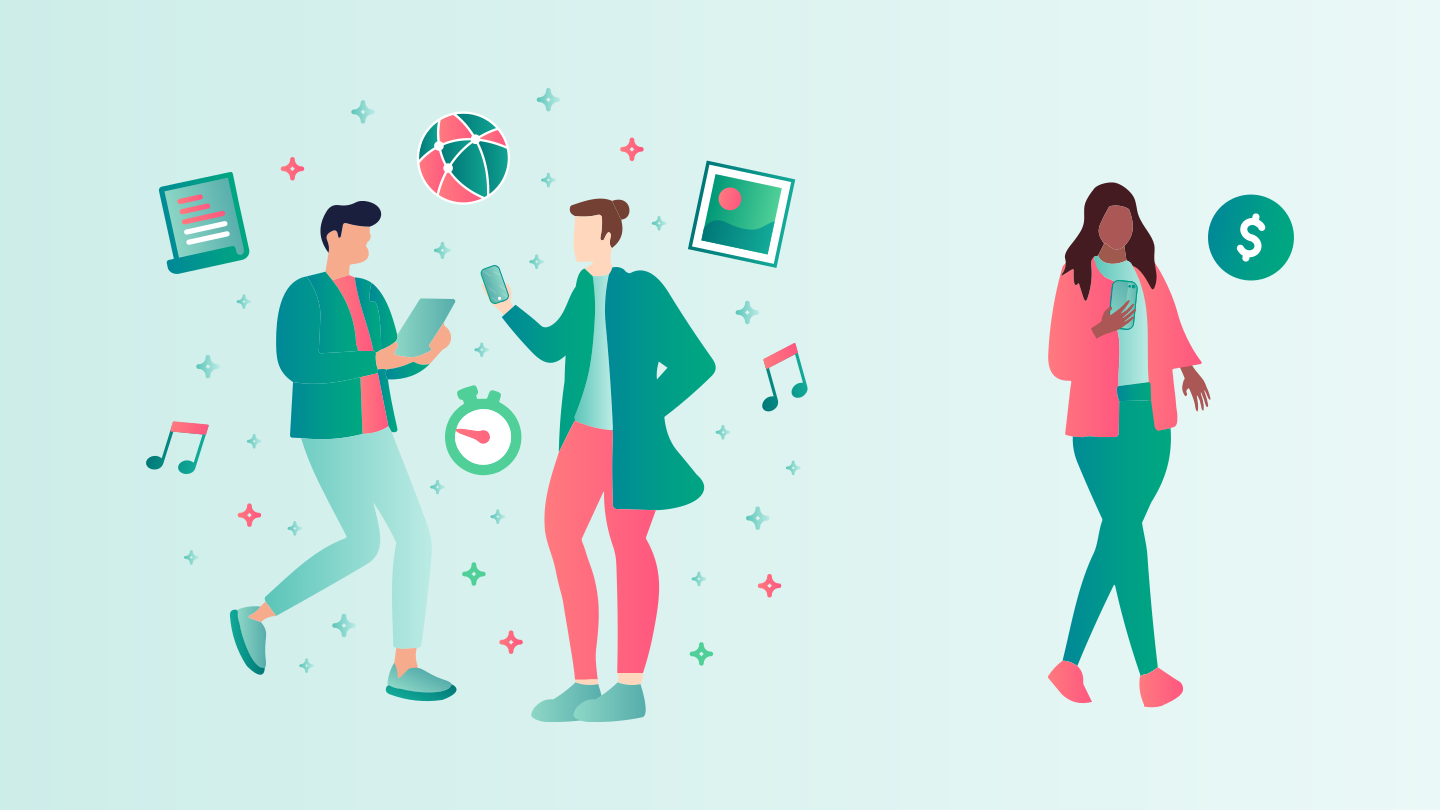
You either pay with money – or with time, data, and free will.
Most of the internet seems like it’s free. We can read the news, watch videos, and scroll through social media for hours without ever entering our payment details. But how does that work? Social media platforms are free to use, yet generate billions in revenue for their owners and shareholders.
The truth is, when we use these platforms, we pay not with money, but with attention, data, and ultimately, with the shaping of our behavior.
Our attention has become the internet’s most valuable currency and our data fuels this vast digital ecosystem. So what alternatives might let us reclaim both our privacy and our freedom of choice?
The Attention Economy
You’ve probably heard the saying, “time is money.” On the internet, time is also profit. Every minute we spend scrolling, watching, or clicking translates into revenue for someone else. Our attention has become a scarce and tradable resource, one that digital platforms relentlessly compete for. The longer we stay, the more data they gather. The more data they have, the more precisely they can target us with ads. And for every impression or click, money changes hands between advertisers and platforms.
To keep us engaged, platforms have perfected the art of distraction. Features like push notifications, autoplay, and infinite scroll are designed to make leaving nearly impossible. Behind the scenes, many large tech companies even work with behavioral psychologists (opens in a new tab), neuroscientists, and other specialists (opens in a new tab) to fine-tune these systems for maximum impact on our brain’s reward circuits—triggering dopamine hits and amplifying our fear of missing out (FOMO). Studies describe how design elements such as variable rewards (opens in a new tab), streaks (opens in a new tab), and disappearing content (opens in a new tab)are intentionally crafted to keep users coming back for more. While we think we’re choosing what to look at, the algorithms are quietly learning from every action we take, and feeding us more of what will keep us hooked.
The Price We Pay
This constant engagement comes at a steep cost. We lose time that could have been spent on more meaningful activities, such as reading a book. However, short-form content, like 280-character tweets or 15-second Reels, has shortened our collective attention spans to the point where sustained reading feels impossible. Constant notifications and rapid dopamine hits fragment our focus, making it hard to process anything longer than a quick scroll. Studies (opens in a new tab) show heavy users struggle with books or articles, as brains adapt to micro-bursts over deep concentration.
This feeds into a deeper epidemic: loneliness. Despite endless “connections,” the US Surgeon General declared loneliness a public health crisis (opens in a new tab) in 2023, affecting half of adults with risks rivaling smoking. Social media worsens it (opens in a new tab) through passive lurking and envy-inducing highlights, replacing real bonds with superficial likes, leaving us more isolated than ever.
Worst of all, we steadily surrender our privacy. Platforms don’t just use your personal data, they correlate it with countless others, predicting behavior and refining their targeting models. Over time, this dynamic grows more insidious. Algorithms learn what triggers our emotions and how to influence us. A politician, for example, might use these insights to run laser-targeted campaigns, showing you only the narratives you’ll respond favorably to. Important context, inconvenient truths, or opposing views conveniently disappear from your feed. In chasing the illusion of personal relevance, we lose perspective, and with it, a measure of our free will.
Seeking Alternatives
So, what can we do? There are small acts of resistance we can make as individuals: using ad blockers, clearing cookies, denying trackers. These steps offer partial protection but don’t change the system that thrives on our data. Subscriptions present another approach: paying directly for content instead of having advertisers foot the bill. But even this model has limits. Subscription fatigue is real, and not every platform has the scale or infrastructure to manage payments. Small creators often get left behind.
That’s where new ideas like Web Monetization come in.
A Fairer Way to Pay: Web Monetization
At the Interledger Foundation, we’re exploring a third path. Web Monetization (opens in a new tab) is an open, growing web standard that introduces a frictionless, real-time way to support content creators directly. Instead of relying on ads or subscriptions, users can contribute small amounts automatically as they browse, like digital donations, but continuously and seamlessly.
“Web Monetization gives publishers more revenue options and audiences more ways to sustain the content they love. Support can take many forms: from a one-time contribution to a continuous, pay-as-you-browse model. Publishers earn the moment someone engages, while audiences contribute in real time, using a balance they control.”
— webmonetization.org
This model doesn’t aim to replace existing revenue systems but to complement them, creating a more open and equitable landscape for both large and small creators. A website with Web Monetization enabled might choose not to show ads to visitors who contribute via this method, preserving privacy without limiting access. The Interledger Foundation actively encourages website owners to offer some sort of benefit to web monetized visitors. Publishers could even offer a few free articles per day to these users while keeping premium features behind subscriptions. In short, everyone wins: creators get fair compensation, and users enjoy content without their data being exploited.
Reclaiming Our Attention
The internet may appear free, but we often pay with what’s most precious: our time, attention, and privacy. The attention economy has transformed users into products, fueling systems that capitalize on distraction and data. But alternatives like Web Monetization point toward a different future, one where creators are rewarded transparently, users retain control over their data, and attention is given, not extracted.
It’s time to rethink how we “pay” online and to rebuild a digital ecosystem that respects creativity, privacy, and human focus.