Who was it for
- Artists, makers, and creative practitioners
- Open to any discipline or background
- Global applicants welcome
Artists imagine a world where money works better for everyone.
In 2023, the Interledger Foundation stepped outside its typical grantmaking cycle and announced the inaugural Future|Money Arts and Culture Grant. We invited artists from any discipline to imagine a world where financial systems work better for everyone.
When looking for new approaches to financial inclusion, the Interledger Foundation turned to artists: people whose minds see the world inventively and creatively. The Future Money Grant was co-designed with artist and innovator Kokayi Walker, and invited creators to challenge the assumptions built into financial systems and imagine alternatives, using any medium or artistic discipline.
“I am fervent in my belief that you cannot create a new world without the minds of artists […] We can see a new world and must be a participant in the conversation.”
– Mia Wright-Ross
The grant offered $25,000 to the chosen artists and a platform to showcase their work. As a prompt, we asked that the proposed pieces consider future themes, such as decentralization, pan-border interconnectivity, financial services that work for people, and new cultural understandings of the fluidity of money.
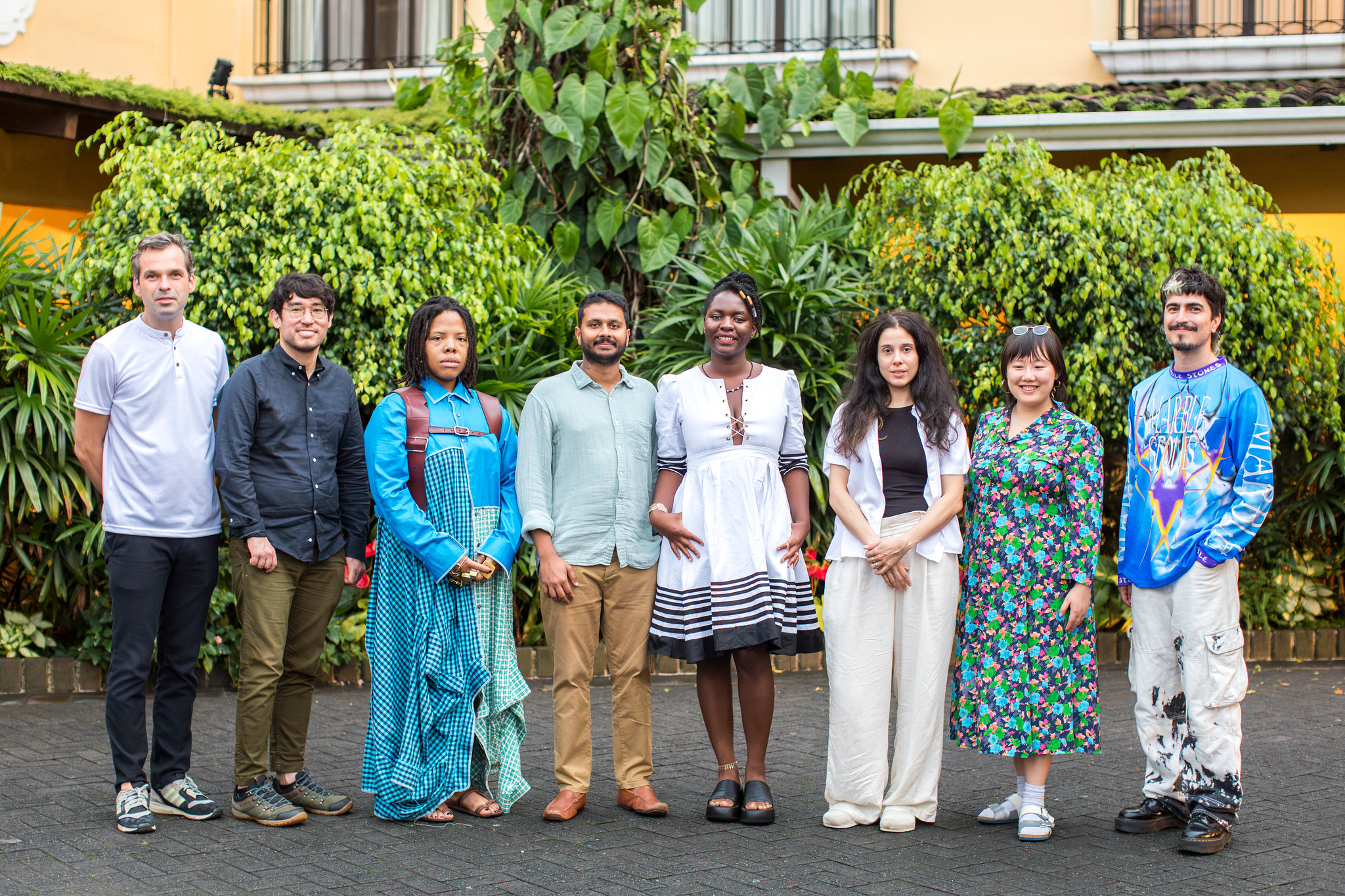
Eight artists were selected from over 100 visionary submissions to explore how technology, equity, and creativity can converge to reimagine how we get paid, collaborate, and thrive. From a collage of lottery tickets to a hologram to an elaborate pencil drawing of a large waterworks, the artists created visions that challenge our understanding of the future of money.
Listen to the podcast (opens in a new tab) and hear the vision for the project.
The Future Money Grant exemplified a bold, intentional effort to bridge the gap between artistic expression and financial inclusion.
Eight artists and collectives were selected from over 100 international submissions. They worked across various media, including film, installation, food art, sculpture, performance, interactive media, and game design. Their projects addressed themes such as digital exclusion, village banking, speculative economics, communal wealth-sharing, and the cultural mythology of money.
The selected works were presented in an exhibition and featured in accompanying documentation, including public presentations and podcast episodes.
Crucially, the Future Money Grant emphasized representation, co-creation, and inclusivity, challenging the traditional gatekeeping that often limits access to funding and visibility for BIPOC, LGBTQIA+, and marginalized artists. Grantees were invited into the design process, ensuring the resulting work was not only innovative but also rooted in community needs, accessible technologies, and systems of care.
By placing artists at the center of the conversation about finance, the Future Money Grant reframed money not just as a tool of the transaction but as a material of meaning, a system of values, and a space for radical reimagination.
Learn more about who supported the judging of the Future|Money Grant
Haitian American artist Charles Philippe Jean-Pierre is making waves at the intersection of art, activism, and international influence. Raised on Chicago's South Side and profoundly inspired by his Caribbean roots, global travels, and academic research, Jean-Pierre creates impactful works that explore community, spirituality, and socio-political systems.
A U.S. State Department Art in Embassies artist and adjunct professor at American University, he has had his work exhibited in embassies in Benin, Malawi, and Niger, as well as in audiences worldwide. He has curated exhibitions at the Embassy of Haiti and spoken at the White House on arts and youth justice at the invitation of President Obama. He has been featured in three Smithsonian shows.
Jean-Pierre's art has a global footprint, from murals in South Africa, Istanbul, and Paris to features in The Atlantic, BET, Ebony, Netflix, and The New York Times. He is not just creating but redefining how we perceive the world.
His DC-based Atelier & Galerie D’Art remains a center for creativity and cultural dialogue.
Kelli Rae Adams transforms clay into conversation. Known for her immersive, installation-based works, Adams employs ceramics, often in varying degrees of permanence, alongside mixed media to challenge economic systems and to reconsider our relationship with labor, currency, and value.
Her thought-provoking works have been exhibited in the U.S. and internationally, including at MASS MoCA, Brown University, the Corcoran School of the Arts & Design, and the Museum of International Ceramic Art in Denmark.
Currently, Adams is a Fields of the Future Research Fellow at Bard Graduate Center in New York. She has held prestigious residencies and fellowships from Halcyon Arts Lab, Anderson Ranch, Guldagergaard, and more. In 2019, she served as a U.S. Arts Envoy to Honduras, leading workshops, delivering lectures, and serving as a juror for the Central American Sculpture and Ceramics Biennial.
Her ceramics journey began with a five-year apprenticeship in Japan under the Karatsu master potter, Tetsuro Hatabe. Her academic credentials include an MFA from RISD and a BA from Duke University.
Using clay as her guide, Adams continues to shape new perspectives on the systems that influence our lives.
Kokayi Walker continues to host the F|M podcast, which blends technology, finance, and culture. It explores how changing systems reshape the way we live, work, and participate in the world.